

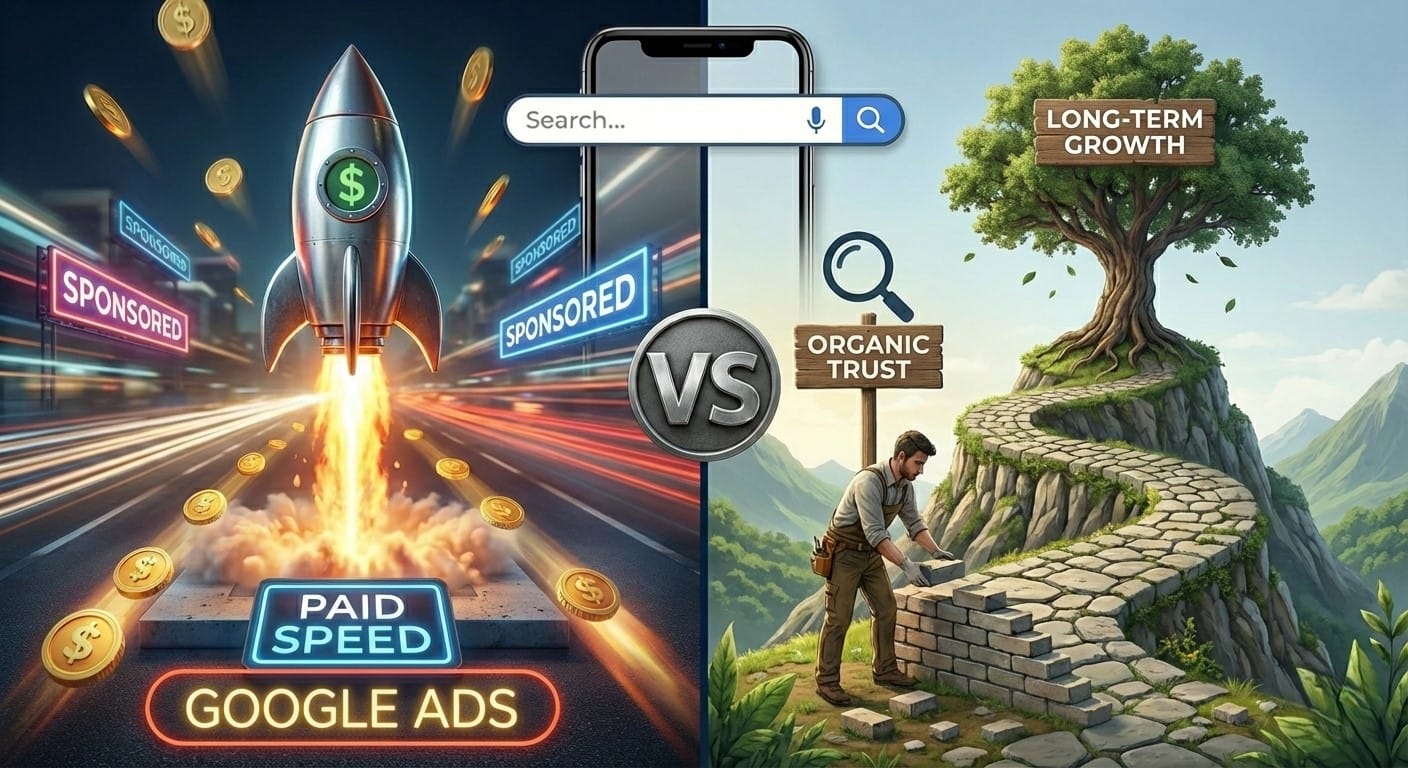
In the fast-paced digital economy of 2026, business owners and marketing directors face a perennial dilemma: Should you invest your hard-earned marketing budget in the slow-burn authority of organic traffic or the instant gratification of paid campaigns?
At 9steps, we believe that every marketing decision should be backed by a clear framework. The “Google Ads vs SEO” debate isn’t just about where you show up on a search page; it’s about understanding the fundamental mechanics of Return on Investment (ROI).
As search engines evolve into “answer engines” powered by AI Overviews and multimodal search, the strategies that worked three years ago are now obsolete. This guide provides a 9-step deep dive into the ROI of both channels to help you make a data-driven choice.
Search Engine Optimization (SEO) has undergone a radical transformation. In 2026, it is no longer just about “keyword stuffing” or “backlink building.” It is about establishing Topical Authority and meeting the rigorous standards of EEAT.
The primary reason SEO remains a cornerstone of digital strategy is its compounding nature. When you invest in organic traffic, you are building a digital asset. Unlike PPC, where the traffic stops the moment you stop paying, a well-optimized piece of content can rank for years.
Imagine your marketing budget as an investment portfolio. SEO is the “index fund” of the digital world. The initial “deposit” (content creation and technical optimization) is high, but the dividends (daily visitors) continue to pay out long after the initial work is done.
Modern consumers are highly skeptical of labeled advertisements. Research shows that even in 2026, a significant majority of clicks go to organic results. Users perceive organic rankings as a “third-party endorsement” from Google. If Google places you at the top, you must be the expert. This trust translates directly into a higher conversion rate for long-form, educational content.
The cost-per-click (CPC) in paid campaigns has risen steadily over the last decade. As more competitors enter the auction, the ROI of PPC can diminish. SEO provides a “moat” around your business, protecting your lead flow from the volatility of the ad market.
To understand why SEO often wins the ROI battle in the long run, we have to look at the “Cost Per Lead” over a 24-month horizon.
Year 1: Your SEO costs might be $5,000/month with low initial returns.
Year 2: Your costs remain stable, but your traffic has tripled.
The Result: Your effective cost-per-acquisition (CPA) drops by 70% compared to Year 1.
In 2026, Google’s algorithms prioritize “Core Web Vitals 3.0.” This means SEO isn’t just about words; it’s about how fast your site loads, how it looks on a foldable mobile device, and how easily a user can find the “9 steps” to solve their problem. Good SEO is simply good web design.
If SEO is a marathon, Google Ads is a 100-meter sprint. There are specific business scenarios where waiting six months for organic rankings is simply not an option.
For a new brand or a product launch, Google Ads offers a “pay-to-play” shortcut. Within hours of setting up a campaign, your brand can appear at the top of the search results for high-intent keywords. This is vital for capturing seasonal demand (like Black Friday or New Year’s resolutions).
PPC allows you to be incredibly specific. You can target users based on:
Geographic location (down to the zip code).
Time of day.
The specific device they are using.
Previous interactions with your brand (Remarketing).
This level of control ensures that your marketing budget is being spent on users who are at the “bottom of the funnel”—meaning they are ready to buy now.
The feedback loop in paid campaigns is instantaneous. You can test two different landing pages or three different ad headlines and see which one has a better conversion rate within 48 hours. This data is “gold” for your business. In fact, many successful “9steps” users run Google Ads specifically to discover which keywords convert best before they commit to a long-term SEO strategy.
The ROI of Google Ads is often more “predictable” than SEO. If you know that every $1 spent on ads generates $3 in revenue, you have a scalable “money machine.”
Google rewards advertisers who provide a great user experience. By aligning your ad copy with a high-quality landing page, you can achieve a high “Quality Score,” which actually lowers your cost-per-click. This is where professional management of your Google Ads Page becomes essential.
| Feature | SEO (Organic) | Google Ads (PPC) |
| Speed | Slow (3-9 months) | Instant (Minutes) |
| Cost Structure | Upfront investment | Pay-per-click |
| ROI Timing | Long-term compounding | Immediate but linear |
| Consumer Trust | High (Earned) | Moderate (Paid) |
| Keyword Control | Broad/Informational | Specific/Transactional |
| Maintenance | Continuous content updates | Continuous budget management |
We cannot talk about Google Ads vs SEO without addressing Artificial Intelligence.
Google’s AI Overviews now answer simple questions directly on the search page. This has hurt “informational” SEO. If your content only answers “What is…?”, you will lose traffic. However, for “How to…?” or “Why…?” queries—the kind of structured, multi-step advice found on 9steps—SEO is more valuable than ever because AI engines cite these authoritative sources.
With the death of third-party cookies, paid campaigns have had to adapt. ROI now depends on “first-party data”—your own list of customers and leads. Both SEO and Ads must now focus on getting users to “opt-in” to your ecosystem (newsletters, webinars, or free tools).
Which should you choose? Follow this 9-step framework to decide:
Define Your Goal: Is it immediate sales (Ads) or brand authority (SEO)?
Analyze Your Budget: Under $2,000/month? Start with SEO. Over $5,000? Diversify.
Check Your Timeline: Do you need results this week or this year?
Evaluate Competition: If the CPC for your keywords is $50+, SEO is the smarter long-term play.
Assess Your Website: Is your site fast and mobile-friendly? If not, Ads will be a waste of money.
Keyword Intent Audit: Use Ads for “Buy [Product]” and SEO for “[Product] Guide.”
Test the Waters: Run a 30-day PPC campaign to find “winner” keywords.
Build the Foundation: Invest 70% of your effort into organic traffic to ensure long-term survival.
Scale with Integration: Use the data from your Ads to write better SEO headlines.
The most successful brands in 2026 don’t view this as an “either/or” situation. They use an Integrated Search Strategy.
By appearing in both the “Sponsored” section and the “Organic” section, you claim more “real estate” on the screen. This creates a psychological effect known as the “Mere Exposure Effect”—the more a user sees your brand, the more they trust it. This synergy can increase your overall conversion rate by up to 25% compared to running either channel in isolation.
There is no “one-size-fits-all” answer to whether Google Ads vs SEO is better for ROI.
SEO is your shield; it protects your brand, builds trust, and ensures you aren’t held hostage by rising ad costs.
Google Ads is your sword; it allows you to strike quickly, enter new markets, and capture high-value customers exactly when they are looking to buy.
For most businesses, the highest ROI is found by starting with a structured SEO foundation and using paid campaigns to amplify what is already working.
To support different digital marketing strategies, we offer complementary services:


